
Imaginative Realism

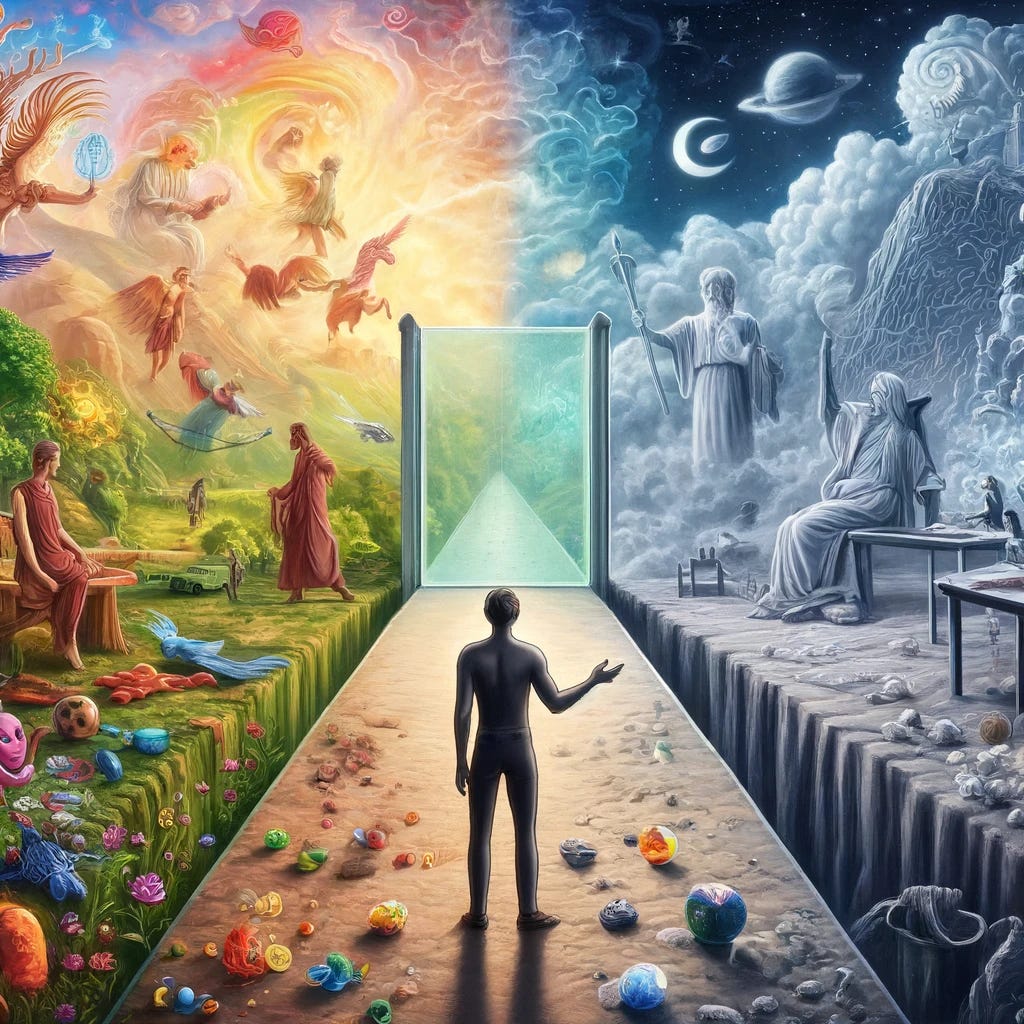
Imaginative Realism
I've realized that I have always had an interest in Imaginative Realism as a philosophy. What are the conclusions of such an idea? Mainly that what is imagined is really real, just like the table and chairs. Of course, if they're really real, the only people that perceive them are the mentally ill or those who have taken particular mind-altering substances.
Perception Issues
Our perception of these imaginative objects and persons is, alas, restricted to our minds which can never picture, listen, or feel those objects and persons as vividly as we see those same tables and chairs. This is a big problem for the imaginative realist because what use is there in making metaphysical claims if we can't see or feel them, especially since these metaphysical claims are talking about the existence of things in the same way that we see other things.
To put it simply, if these imaginative things are real like everything else, where are they?
The Religious Perspective
The religious in human history have had this problem for generations. "Yes," they claim, "The gods are really there just like us, human beings!" But we go to Mount Olympus and we see that no, they are not there.
Two Paths
One can now go in two different paths:
They’re really here, you just can't see them (for whatever reason).
They’re not really here, but they are softly here.
In our secular age, most have gone to the second answer. This is the realm of the so-called "metaphorical truth." Metaphorical truth is hard to pin down, though it's usually an escape hatch for the imaginative realist—that is, it's a way of saying, "These beliefs are so important to our lives that we should believe in them anyway, regardless of their being actually true."
As such, imaginative realism is demoted to no longer having the transcendental ranking of "True" and is instead a private novelty.
If we stick to them being really there, we just can't see them, we're essentially in the same situation as the second path. If we can't perceive them, why claim that they're real without appealing to metaphor?
Belief
Here we come to the reasons we believe what we do. If the antifoundationalism guys are right, the "why" is merely sociological. As such, appealing to "metaphorical truth" is just another way of saying that: a) There isn’t actually true belief. b) There is a conflict between the two interpretive communities a person is in.
In a certain sense, this is a more behavioral account of belief, rather than anything essential to the ideas.
Said another way, a belief is something that an individual within an interpretive community conforms with. It is a picture of the world or use of words that further encourages more reinforcement or punishment.
On the other hand, the more common way of looking at belief is seeing belief as a result of a pros and cons list based on believing something. These pros and cons can be purely logical, utilitarian, consequentialist, etc. As such, whether to believe in something depends on the values one already has.
So, whether to believe in something that can't be seen is really a relative exercise (alas, alas). The question is not whether we can believe in it, but whether we do or not. If one commits oneself (a misnomer, we are already committed) to what one believes, then one believes what one believes and if one believes in imaginative realism, then one already believes in it!
Conclusion
In the end, one believes what one does and once one is trying to find reasons for what they believe, they likely don't believe in it, and the game is already over.
As such, debate and idea communities are used, not as a way to change one's beliefs—instead, they're used to talk about what one doesn't believe, with the dim, neutered hope that if one receives indoctrination long enough, their minds would change. If one already is confident in what they believe, one then talks about what they believe in and tries to "destroy" the other side in a game of power and social humiliation.
To try to prove something is either a mark of arrogance or insecurity, with little in between. That which we really believe, we either don't talk about or try to silence those that believe in the opposite.
Even the self-described pluralists and relativists have their limits in their own beliefs. They may be interested in points of view that they do not believe in, but only because they are unsure if they believe in the other side. As such, they are tolerant only of the views they are actually tolerant in.
This is the issue over the paradox of tolerance. It's not like I can be tolerant of what I am intolerant of—by virtue of my being intolerant of it, I am intolerant of it!